Participants proposed solutions, mainly in artificial intelligence, data science and robotics, to solve problems related to Maritime Situational Awareness. Each team will receive USD 7,500, and at the end of March the two winning teams will be selected: first place will receive up to USD 50,000 and second place USD 40,000.
Nine teams make up the first cohort of the Avante Challenge, an initiative led by the Chilean Navy (Armada de Chile) with the support of Know Hub Chile and AthenaLab. Originally, eight teams were to be selected, but given the high level of the proposals related to Maritime Situational Awareness (or Maritime Domain Awareness, MDA), the jury decided to add one more initiative.
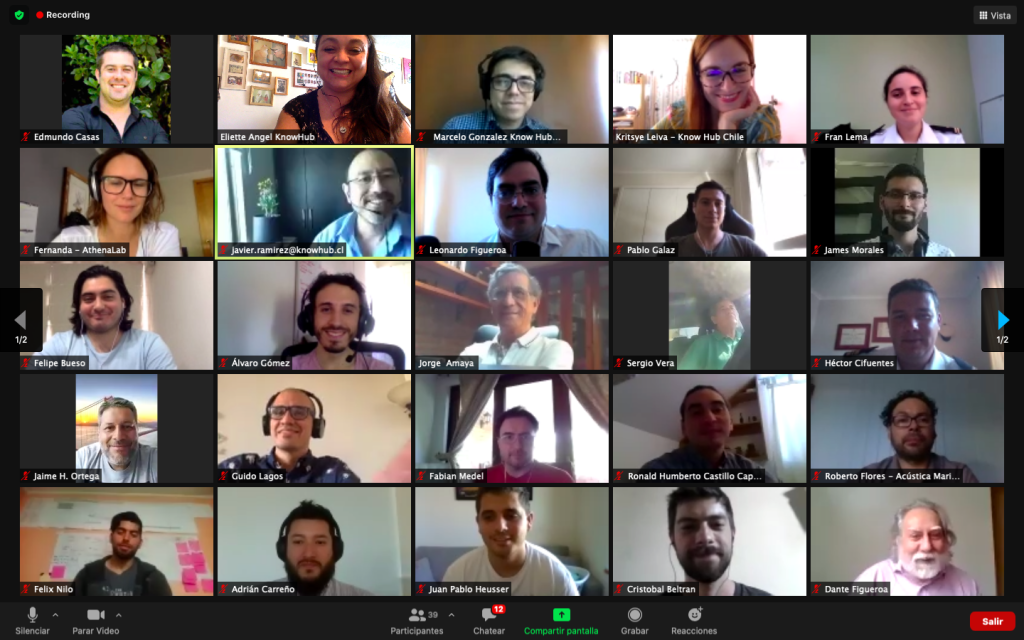
In total, 39 proposals applied to the 2020 Avante Challenge. Of the nine selected teams, five come from the regions (La Serena, two from Viña del Mar, Concepción and Valdivia), and only one is led by a woman, Marcela Ruiz, director of the startup Acústica Marina. In addition, four teams are led by university researchers (from the Universidad de Chile, Universidad de Santiago and Universidad de Concepción) and five are startups or companies (the list of winners is below).
The nine teams began their Dual Tech training for the development of dual technologies on Thursday, January 7 (10 weeks, between January and March). During this process, they are being guided by seven mentors and must build a Minimum Viable Product (MVP). They are also receiving company setup support to form or mature their venture (corporate and tax legal structure, team building, intellectual property strategy, among others).
All teams will take part in a pitch at the end of March 2021, where the two winners will be chosen and will access up to USD 90,000 in total: the first up to USD 50,000 and the second up to USD 40,000. These resources are to implement the roadmap, create or strengthen the venture and, in general, carry out the activities needed to implement and commercialize the technological solutions.
To read the announcement of the close of the 2020 Avante Challenge call, with more details about the initiative, click here.
The nine selected teams and their leaders are:
- VIGIAS: a swarm of drones aboard a trimaran-type Autonomous Surface Vessel for real-time monitoring, speeding up reaction times in identifying illicit activities. Félix Nilo (La Serena).
- Acústica Marina: a vessel detection system using hydroacoustic technology with real-time data processing. Its purpose is to improve the quality of information and optimize inspection operations for smaller vessels along the country’s northern coast. Marcela Ruiz, director of the startup Acústica Marina (Valdivia), with support from the Universidad Austral de Chile (UACh).
- Maritime Geospatial Intelligence (MGI): a real-time tracking, control and alert software platform that analyzes vessel behavior with Artificial Intelligence to detect illicit activities and accidents, prioritizing them according to a Maritime Risk Index (MRI) and indicating where accidents and illicit activities are concentrated. Felipe Bueso, Universidad de Santiago de Chile.
- Smooth: a vessel detection and tracking system based on HF radar technology to expand the Maritime Surface Picture by permanently detecting non-cooperative vessels. Dante Figueroa, Universidad de Concepción and the company DSS.
- K-oversight: integrated technological solutions for continuous and automatic monitoring to prevent potential illicit activities by processing and analyzing, with AI, the images captured from the Navy’s various aircraft and generating georeferenced alarms in real time. Gisela Ramírez and Edmundo Casas, startup.
- CIRCE: a risk map for detecting anomalous behavior and illicit activities using georeferenced information and interagency intelligence, in order to expand the surveillance area and focus maritime inspection efforts. Jaime Ortega, Center for Mathematical Modeling, Universidad de Chile.
- IA Grafimar: an automated real-time maritime traffic analysis system, increasing the Chilean Navy’s capacity to detect illicit acts and direct search and rescue operations at sea using Artificial Intelligence. Dr. Sergio Vera (Viña del Mar).
- Prognos-spyglass: a digital platform that provides the Maritime Rescue Command Center and maritime police analysts with classified data for the effective detection of anomalous vessel behavior. Gabriel Gatica, General Manager of the startup ARTIFICYAN (Viña del Mar).
- SmarTrack: a maritime control tool to support the work of Maritime Rescue Command Center operators and analysts, in order to increase and automate the detection of cases of interest within Chile’s area of responsibility. Cristóbal Beltrán, Center for Mathematical Modeling, Universidad de Chile.