

I invite you to imagine the following situation: after decades of effort, dedication and sacrifice (personal and professional) in the service of a university, you finally manage to synthesize that molecule, refine that protocol, identify that therapeutic target, code that algorithm or design that device that will change everything. Perhaps that work won’t revolutionize the world. Or perhaps it will. But you know it will definitely make a contribution to people’s lives or to the work of the specific industries where your development is applied.
You also know that this effort was not only intellectual. It also involved management. Without neglecting your teaching and family obligations, you had to write countless proposals to obtain the public funding that would let you advance your idea. You also had to venture into disciplines somewhat removed from your scientific training and learn to use “esoteric” concepts such as “customer”, “business model” or “market size”, which are absolutely necessary to secure the support of private companies that public funds require as a condition for awarding you those R&D projects.
Now in the final phase of this long journey, you reach the sad conclusion that the world is not yet ready to adopt your technology. You know that the only way to refine it and turn it into a product that is actually used in society is to do it yourself.
So you sharpen your political skills and set off on the convoluted path of convincing your university’s authorities that the venture you want to launch, your spin-off, is not driven solely by petty interests and the pure pursuit of profit, but is the only way to turn your scientific results into a product, on the market and for the benefit of society. That is when you start to miss your days in the lab, when objective data and pure logic were enough to advance your career. But just as you are about to throw in the towel, it happens: each and every university committee and authority finally gives its approval.
Your spin-off will see the light of day. And although it is just an intermediate milestone in this marathon, you now know you can move forward, and that each day brings you closer to the moment when your science becomes innovation, except for one small detail: your spin-off isn’t really yours. Or, put another way, you can own at most 10 percent of it. Nor can you be its CEO or take on management roles in it.
This story, with all its obstacles, is precisely one of the main problems that the technology transfer bill, promoted by the Ministry of Science, seeks to solve. The bill has just advanced to its second constitutional stage. The restriction stems from a combination of rules intended to regulate other situations (such as administrative probity), but which unfortunately are also a gigantic obstacle to the science produced in our public and private universities becoming products and services with real impact on society. It is not just about correcting an obvious injustice, but about creating the conditions for the emerging science-based startup (EBCT) to actually get the support it needs to achieve its goal.
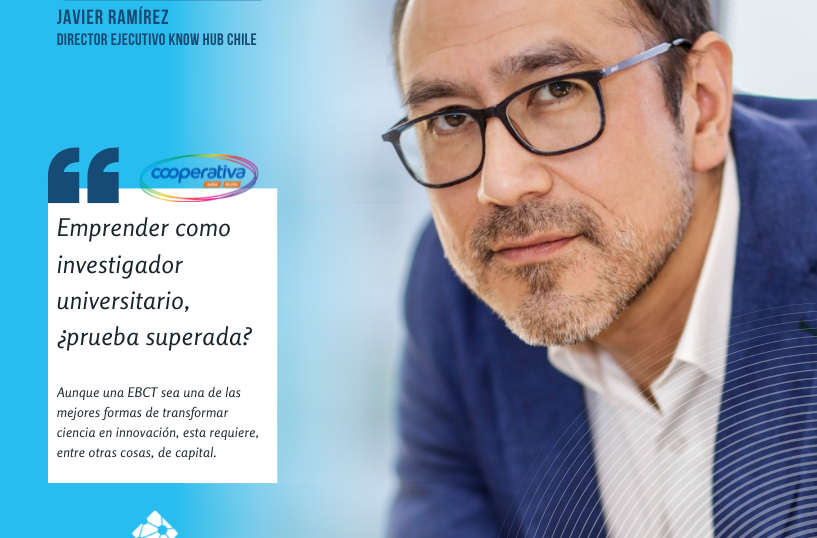
Although an EBCT is one of the best ways to turn science into innovation, it requires, among other things, capital. Given the risk they represent, this can only be obtained from public funds or private investors (VC, for Venture Capital). A VC examines many aspects before deciding to invest, one of the most important being the team behind the EBCT. In other words, it bets on the people who show the capability and commitment needed to overcome all the obstacles they will face along the way. And of course, it is not a very good sign if the project’s founder holds a minority stake in their company and cannot take on a management role in it.
This is just one of the aspects addressed by the bill which, if approved, will give an extraordinary boost to turning our science into innovation, to the creation of highly skilled jobs, to sophisticated high-return investment and, in general, to Chile’s evolution toward a knowledge society.

Javier Ramírez
Executive director, Know Hub Chile
Read the original column here: https://opinion.cooperativa.cl/opinion/ciencia-y-tecnologia/emprender-como-investigador-universitario-prueba-superada/2024-10-28/223747.html