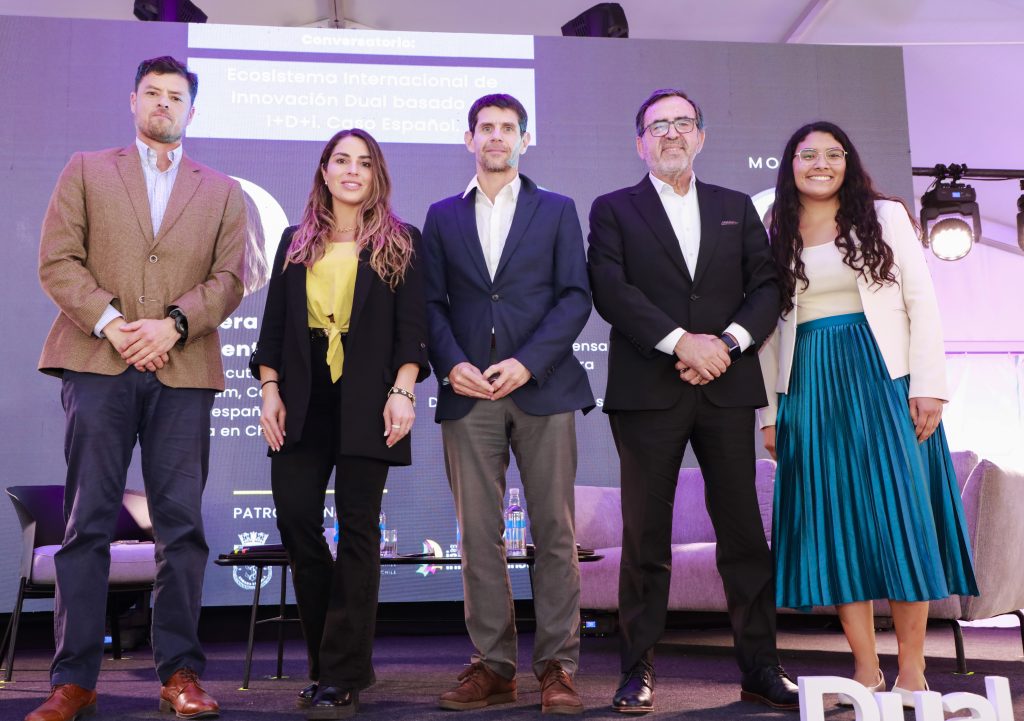



The event, organized by Know Hub Chile together with the Chilean Navy’s Technological Innovation Center (CiTA) and Innovapolinav, brought together representatives from defense, academia, industry and government, establishing Chile as a regional benchmark in dual innovation.
Reaffirming growing national interest in dual innovation, the third edition of the Dual Hub Summit: Dual Innovation Ecosystems in Chile was held on October 24 at Innovapolinav, Viña del Mar, as part of the 8th Innovation Meeting of the Chilean Navy (Armada de Chile).
The event, organized by Know Hub Chile in partnership with the Navy’s Technological Innovation Center (CiTA) and Innovapolinav, brought together authorities, researchers, entrepreneurs, and representatives of the private sector and the Armed Forces to analyze the progress, challenges and opportunities of dual innovation in Chile, understood as the development of technologies applicable to both defense and civilian use.
From its first edition in Concepción to this third edition in Viña del Mar, the Dual Hub Summit has established itself as a key space for promoting collaboration between science, government, industry and defense. This time, the event showcased concrete cases of technology transfer, applied research initiatives and cooperation strategies between national and international institutions.
“The Dual Hub Summit has become a benchmark forum for the dual innovation ecosystem in Chile. The partnership with the Chilean Navy, through CiTA and Innovapolinav, shows that innovation is not built in isolation: it requires collaboration among all of the country’s strategic players,” said Javier Ramírez, executive director of Know Hub Chile.
Technological sovereignty
Among the main international speakers was Lars Frølund, an academic at the Massachusetts Institute of Technology (MIT), board member of the European Innovation Council Fund (EIC Fund) and former advisor to the NATO Innovation Fund (NIF), who presented the keys to designing dual innovation ecosystems and the importance of connecting scientific capabilities with national development strategies.
Likewise, Arturo Ojeda Demaria, specialist at the Intelligence Surveillance & Reconnaissance Technology Development Unit of the United Nations Global Service Centre, addressed global challenges in maritime security, coastal resilience and technological cooperation, highlighting Chile’s role as a relevant player in coordinating dual solutions with global impact.
The day included panel discussions and presentations on innovation experiences in defense, technology startups and university-industry collaboration. Attendees agreed that dual innovation offers a strategic opportunity to strengthen technological sovereignty, boost the knowledge economy and build high-value national capabilities.
“Dual development makes it possible to harness the country’s scientific and technological potential to tackle challenges in security as well as productivity and sustainability. This approach is aligned with national science and defense policies, and it promotes a culture of collaboration that strengthens innovation as a public good,” Ramírez added.
The event also highlighted the importance of the joint work between Know Hub Chile and the Chilean Navy, in an effort to coordinate technology projects that respond simultaneously to the country’s strategic needs and to citizens’ well-being.
With more than a decade of progress in science, technology, knowledge and innovation (CTCI) policy, Chile has begun to integrate dual innovation into its strategic instruments, such as the National Defense Policy, the National CTCI Strategy and the National Shipbuilding Plan, strengthening knowledge transfer and the creation of sustainable technological capabilities.
The Dual Hub Summit is set to be a space for continuing and expanding collaborative work between defense, academia and industry, reaffirming that dual innovation is an essential tool for building a safer, more competitive and technologically sovereign Chile.