
Chilean device gives blind people “complete freedom”

Know Hub News
· Santiago

MOV picks up the vibration signals emitted by different objects and communicates them to the user. The aim is to do away with the cane.
Source: Diario Hoy x Hoy
More than 314 million people worldwide live with some degree of blindness, and of that total, the World Health Organization (WHO) estimates that around 45 million are completely blind. In Chile, the National Disability Service (Senadis) reports that there are more than 850,000 people with visual impairment and 80,000 who are blind.
When these people want to get around on their own, the white cane is essential to detect obstacles and holes, avoiding collisions and falls.
However, the cane only warns of objects located from the person’s elbow down, so anything higher up is not covered. As a result, blind people are exposed to accidents with trees, signs, windows and so on.
The cane also keeps one hand occupied, and its use can lead to carpal tunnel syndrome, tendinitis and bursitis. That is why a Chilean invention could be revolutionary.

The device
MOV is led by Universidad de Talca academic Silvana Herrera, who explained that “it is a system that mimics the echolocation of bats and dolphins and, in addition to aiding spatial orientation, gives the user greater mobility by freeing their hands from the cane, which will no longer be needed”.
Because of its innovative nature, the device the expert has been working on since 2018 has drawn the interest of the Spanish National Organization of the Blind (ONCE). In addition, tests with Chilean users have produced very positive feedback.
One such user is Maribel Silva, president of the Agrupación Centro de Capacitación de Ciegos y Limitados Visuales, who described it as “complete freedom, a marvel, because you can walk without bumping into things (…) At home it’s not easy to bump into things, but on the street there are more and more things that keep you from walking freely”.
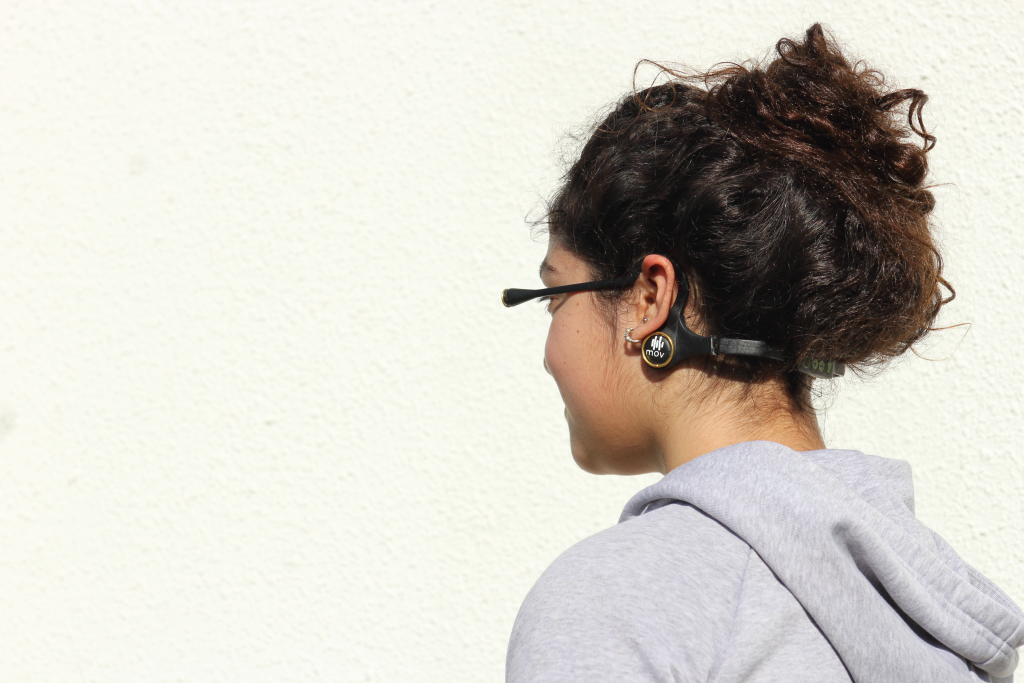
The device consists of a headband. It resembles headphones with a band behind the head and activates two vibration motors behind the ears which, at different intensities, warn of any obstacle.
“With a 270-degree scanning field, similar to that covered by human stereoscopic vision, and a range of four meters to the front and sides, the user gets far more information in real time than a cane could provide”, Herrera noted. It uses the vibrations emitted by objects, which are picked up by ultrasonic sensors in the auriculocranial area and on the occipital bone, making it possible to determine their location.
Distances are measured by two lasers that “scan the surroundings and transmit that information to the user through a set of vibration signals that are very easy to understand”, she added.
In 2020, MOV was one of the winners of a program run by Know Hub Chile and the University of California, Riverside (U.S.) that supports the creation and maturation of science- and technology-based startups, and it is now part of the organization’s portfolio. Herrera was also awarded Corfo Semilla Inicia funding for Women-Led Companies.

Learn more about MOV