

Chilean women inventors: their growing numbers place Chile third in the OECD for gender equity in patents

Know Hub News
· Santiago


Source: La Tercera
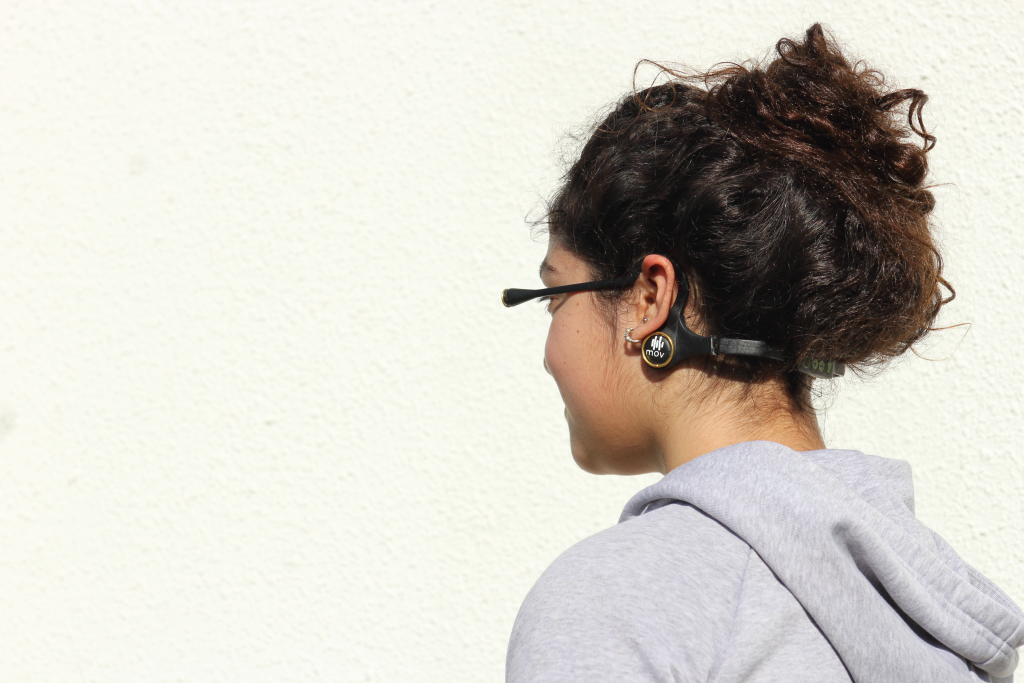
In 2018, Silvana Herrera was in her final year of Design, specializing in Product Design, at the Universidad de Talca. She had to present her thesis project and wanted to create something with impact, but she wasn’t sure what; she knew only one thing: she wanted to work on inclusion.
One day, while stuck on her research because she didn’t know how to steer it, she was waiting to cross the street when she met Michael Moraga, who has been blind since the age of seven. Silvana offered to help him cross, not knowing he would end up helping her more than anyone else.
Through Michael, she became aware of the problems with the white cane and that it had not yet evolved. Silvana says: “I saw the design opportunity to create a new prototype so that people with visual impairments can get around.” That is how MOV was born.
MOV Designs is a science- and technology-based venture led by Silvana Herrera, CEO of the brand, who in addition to being a designer holds a master’s degree in Industrial Design and Product Development. MOV uses sonar field technology for spatial orientation for people with visual impairments. The device is worn on the back of the head and aims to replace the white cane, freeing up their hands and giving them greater independence in society.

Like Silvana, hundreds of Chilean women have patented things never seen before in the world. These are Chile’s women inventors, and according to the Gender Report: Analysis of Women Inventors, released by the National Institute of Industrial Property (Inapi), Chile ranks third among OECD countries for gender equity in international science and technology patent applications.
Jovanka Trebotich, technology transfer coordinator at Know Hub and member of the ScienceUP Advisory Council and the Association of Independent Producers (API), views the report’s results favorably, but also with restraint and a broad perspective.
“This third place in gender equity in science and technology patents reflects the good research and development (R&D) being carried out in Chile,” she says, but adds that there is still room for improvement.
She also highlights the market focus of invention patents, meaning that they are addressing a current market opportunity and need and seek to help solve them and make an impact on society. “Indirectly, that points to Chile’s economic growth and shows we are taking the right steps toward a knowledge society, as most OECD countries are.”
Silvana says the problem that struck her most in the world of people with visual impairments was that the white cane had not yet evolved. People told her they had calluses on their fingertips, some had carpal tunnel syndrome from the repetitive use of the cane, and others had had problems because the cane did not cover the area from the waist up.

So she began working with ultrasonic sensors, moving on to laser sensors, which map the space and indicate distance through vibrations, replicating the function of the cane without the physical repetition, so users can walk with their hands free.
Visual impairment prevents people from using their hands on the street, depriving them of everyday things such as walking hand in hand with someone. “Everyone I interviewed told me, ‘if you give me the chance to walk two blocks holding someone’s hand, you’ll change my life,’’’ says Silvana, noting that her project, rather than being “super high-tech,” is social: “it’s about giving them long-term autonomy.”
The report also revealed that, according to data from the World Intellectual Property Organization (WIPO), the share of Chilean women inventors in invention patent applications (PCT) reached 26.2%, up 5.4 points from 2020. This increase placed Chile 9 percentage points above the global average of 16.5% of women inventors in PCT applications.
This is a new phenomenon because, although there is a large global gender gap in this area, Chile saw growth of 5 percentage points compared to the previous year (21% in 2020 vs. 26% in 2021). This is explained by the fact that the main users of the PCT system in Chile are universities, which have a higher proportion of women applicants.
When Silvana defended her MOV thesis project at the university, her professors were the ones who backed the project and told her she could patent it. Once the idea was accepted, they met with the institution’s lawyer, who started the process. “The university has helped me a lot. It gives me the freedom to use its infrastructure and to apply for funding with its backing; in that sense they have been really supportive,” she says.
The largest share of women inventors, 58%, work from universities. Companies come second with 21%, and individuals last with 14%. This has been a trend; however, compared to the previous year, the share of women inventors from large companies rose by 3.9 percentage points and the participation of women inventors from SMEs increased by 4 percentage points.
Read the La Tercera article here: https://www.latercera.com/que-pasa/noticia/inventoras-chilenas-cada-vez-son-mas-y-posicionan-a-chile-como-el-tercero-de-la-ocde-con-mayor-equidad-de-genero-en-patentes/CHJES3SBVRFPDDXTHE2ITENUYM/
Learn more about MOV: