How the sensory band that guides blind people works

Know Hub News
· Santiago

Source: Las Últimas Noticias
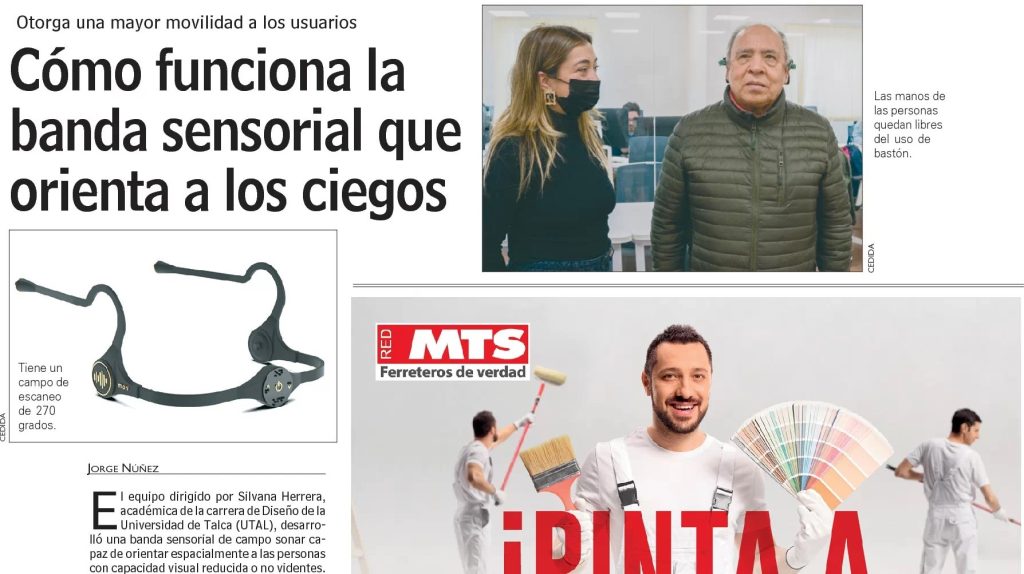
The team led by Silvana Herrera, a professor in the Design program at the Universidad de Talca (UTAL), has developed a sonar-field sensory band capable of providing spatial orientation to people who are blind or have low vision.
“It is a system that mimics the echolocation of bats and dolphins and, in addition to aiding spatial orientation, gives the user greater mobility by freeing their hands from the cane, which will no longer be needed,” explained the researcher, who has been working on the prototype since 2018.
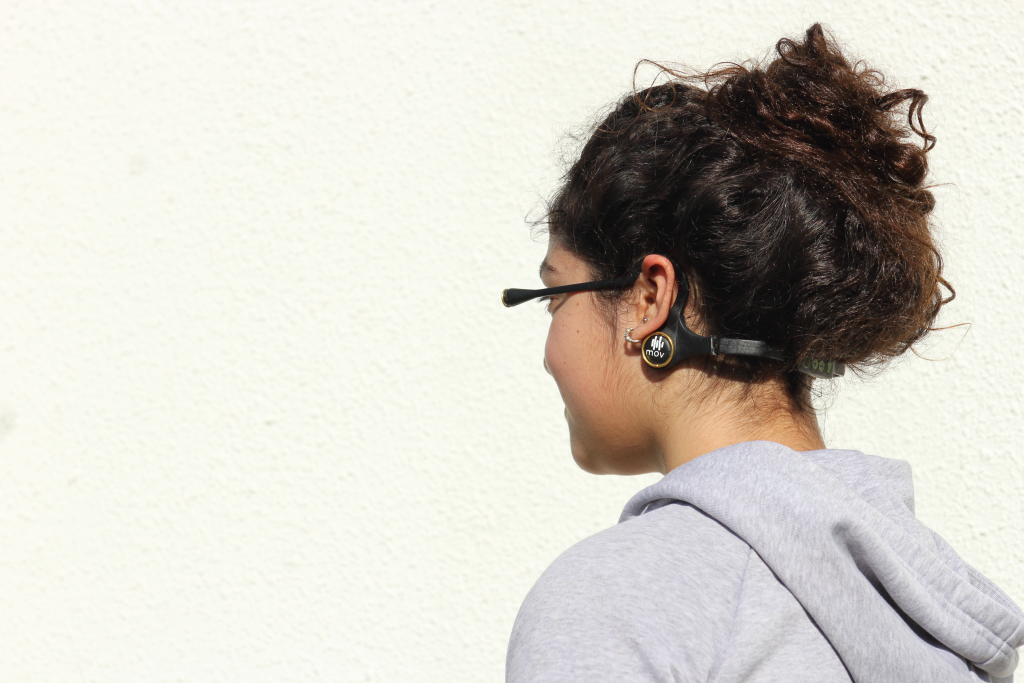
Similar in appearance to headphones designed with a band behind the head, it is a light, portable device that activates two small vibration motors behind the ears, which, through different intensities, can warn of any obstacle in the way.
“With a 270-degree scanning field, similar to that covered by human stereoscopic vision, and a range of four meters to the front and sides, the user gets far more information in real time than a cane could provide,” said Herrera.
Regarding how the information is collected, the researcher explained that “the distances are measured by two lasers that scan the surroundings and transmit that information to the user through a set of vibratory signals that are very easy to understand.”
The design, which has already attracted the interest of the Spanish National Organization of the Blind (ONCE), has been successfully tested in UTAL’s laboratories, where Maribel Silva, president of the Training Center for the Blind and Visually Impaired of Talca, highlights the device’s strengths. “Once you understand the signals, you feel a great sense of freedom and security of movement, especially in the upper part of the body, because the cane warns you about what is on the ground, not what is above your waist, so sometimes we can hit our face, which can be very painful.”
Learn more about MOV