More and more students want to start businesses, and universities are adapting to support them

Know Hub News
· Santiago

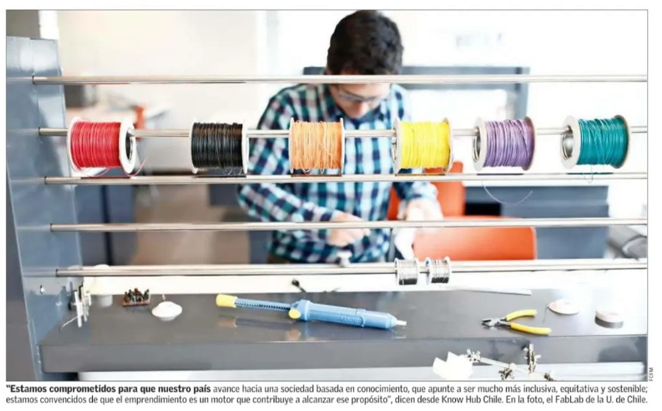
Source: El Mercurio

One in three (36%) university students in the country is trying to start their own company, according to the Global University Entrepreneurial Spirit Students’ Survey (Guesss), the most recent survey on the subject. The initiative measures young people’s entrepreneurial attitudes, aspirations and intentions around the world, and in Chile it showed an increase compared with the last measurement in 2018.
“More and more university students are doing everything they can to start a business. Just as important as this figure is the one related to how they see their careers. In this regard, an important step forward seen in the 2021 results is that more and more students see the possibility of starting a business immediately after graduating (17%). This indicator has risen by 10 points compared with 2018,” says Gianni Romaní, director of the Centro de Emprendimiento y de la Pyme (Cemp) at U. Católica del Norte and lead researcher of the Guesss Chile project.
The survey data show that 7 out of 10 students believe their university has a favorable climate for entrepreneurship and that their institution motivates them to get involved in this kind of activity. And 63% feel that their university inspires them to develop ideas for new businesses.
“Nationally, in recent years we have seen a strong push from both the public and private sectors for innovation and entrepreneurship, understood as fundamental to the country’s development alongside science and technology. This has driven universities to incorporate entrepreneurship and associated skills as a relevant part of the training of their future professionals,” says Alejandro Pantoja, executive director of OpenBeauchef, the innovation and entrepreneurship center of the U. de Chile.
Through courses (both curricular and extracurricular), the center offers support programs for those interested in starting a business, providing support from experts “who give them the content, networks, experiences and tools they need to move their projects forward quickly,” says Pantoja.
More women
To this end, there are mentoring programs and incubators, as well as a fablab for prototype development.
Regarding the entrepreneurial profile, Pantoja explains that they are largely engineering students, generally in the final years of their degree. And he celebrates “that in recent years we have seen women’s participation increase from 10% to 35%.”
Guesss data show that nationwide, the proportion of female university students starting a business rose from 47% in 2018 to 50% in 2021.
At U. Austral, “a greater female presence is also starting to be noticeable,” says Germán Rehren, director of the institution’s Development and Innovation Department, where student entrepreneurship is fostered through initiatives such as entrepreneurship fairs, the Austral Incuba business incubator and the 14K Innovation and Entrepreneurship Center.
Likewise, “the university has included, and continues to develop, changes to its curricula, incorporating in several degree programs a body of knowledge, thematic skills and the use of tools specific to entrepreneurship. In this regard, we have been moving from rather theoretical courses on entrepreneurship and entrepreneurial skills for specific degree programs to other, more flexible formats of cross-program courses.”

About the study
“Guesss is one of the most ambitious research projects in the world on university entrepreneurship,” says Gianni Romaní, director of the Centro de Emprendimiento y de la Pyme at U. Católica del Norte and head of the project in Chile. “It was born in 2003 under the University of Bern (in Switzerland), and more than 50 countries with over 1,000 universities took part in the 2021 edition,” she adds about the initiative, which Chile has been part of since 2011.
The study’s data are collected every two or three years through an online survey, and for the 2021 edition Guesss Chile had the support of Escondida BHP. In the latest national edition, more than 20 universities across the country took part in Chile, gathering data from more than ten thousand students.
Details of the study can be found on the website www.cem-pucn.cl.
A different mindset
Although progress has been made, Romaní warns that student ventures are still concentrated “in the retail sector, characterized by low added value,” and that “the great challenge for Chilean universities is to encourage students, particularly those in science and technology programs, to steer their ventures toward technological sectors with higher added value that are scalable and sustainable.”
In this regard, Fernando Venegas, technology transfer manager at Know Hub Chile (a science and technology transfer initiative that emerged from Corfo and has eight partner universities), says that “a couple of successful Chilean startups is not enough; we must be able to change the mindset of our potential entrepreneurs. That is no easy task, since it means breaking paradigms that are born in the family, reinforced at school and intensified at university, such as the constant search for stability and the fear of failure, two traits that undermine the emergence of an entrepreneurial culture.”
Another obstacle they work on together with universities is “network building, since relational capital is probably the biggest challenge Chilean entrepreneurs face,” he adds.

At U. Católica de Temuco, one way of building networks is by organizing “various training talks on business models, digital marketing and intellectual property, among others,” says Carlos Lüders, its Vice-Rector for Research and Graduate Studies. Likewise, its Directorate of Innovation and Technology Transfer builds ties “with intermediate and advanced students (4th or 5th year), as well as with graduates and graduate students.”
In a world marked by “the uncertainty caused by rapid and constant change,” university support for entrepreneurship is key to training professionals who can face the challenges of the 21st century, reflects Alejandro Pantoja.