
MOV, the device that helps visually impaired people walk more safely with technology that mimics bat and dolphin echolocation

Know Hub News
· Santiago

The goal of this technology, part of Know Hub Chile’s portfolio, is to support the independence of blind and visually impaired people, who number more than 850,000 in the country. The science-based startup (EBCT) also recently won Corfo funding for women-led companies.

World Health Organization data indicate that there are more than 314 million people with varying degrees of blindness worldwide, of whom approximately 45 million are completely blind. In Chile, figures from the National Disability Service, Senadis, indicate that more than 850,000 people have a visual impairment, of whom approximately 80,000 are blind.
For all of them, the white cane is essential for finding their way in the streets and around the city. With its help they can detect many obstacles, especially those at ground level, such as steps or holes. But they cannot detect those above shoulder level, such as trees, signs, billboards, window guards and many other objects.
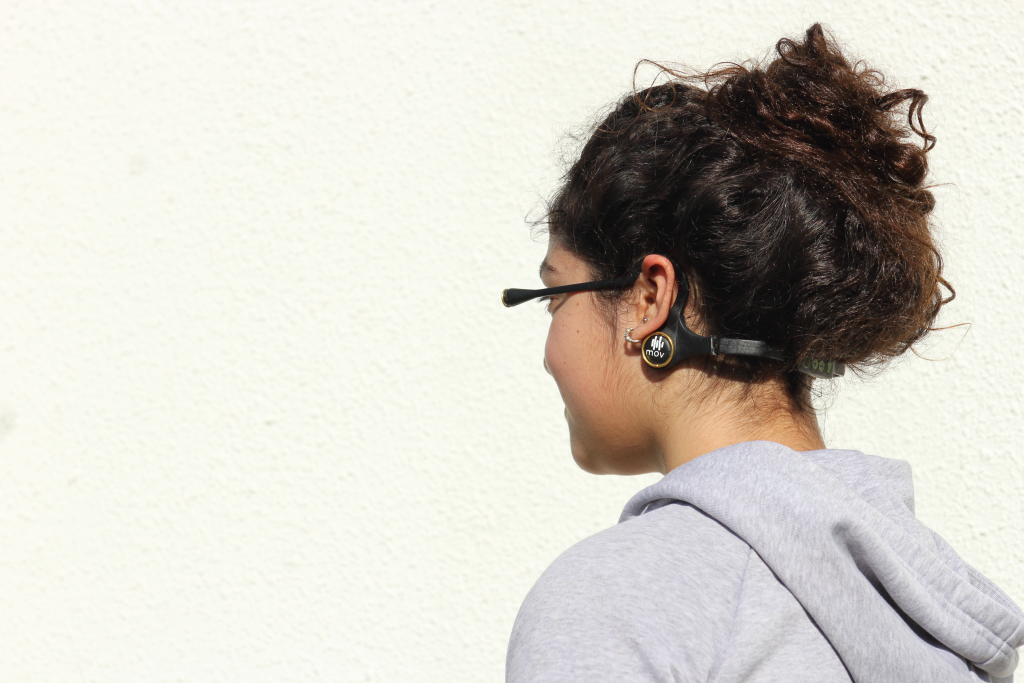
A science- and technology-based venture in Chile seeks to change that. It is MOV, part of Know Hub Chile’s portfolio, led by Silvana Herrera, a faculty member at Universidad de Talca, which has developed a sonar-field sensory band that mimics the echolocation of bats and dolphins and facilitates spatial orientation for visually impaired people without requiring the use of their hands, helping them integrate into society.
There is nothing similar in Chile or the world. The technology even drew interest from the Spanish National Organization of the Blind (ONCE) to test the device, which has already been tested nationally. Users’ feedback has been very positive.
Sonar-field band
The idea took shape in 2018. Silvana Herrera was in her final year of Design, with a specialization in Product Design, at Universidad de Talca, and for her thesis project she was thinking of something with social impact.
She thought about inclusion and then narrowed it down to a specific area: the problems many visually impaired people had with the white cane. I saw the design opportunity to create a new prototype so that visually impaired people could get around.” That is how MOV was born.
The mobility of visually impaired people is hindered by the use of their limbs (arms and hands) when using the cane as a mobility aid. These devices invasively interrupt haptic development (touch and sensation behavior) in recognizing physical space.
In addition, constant and repetitive use of the cane leads to long-term conditions such as carpal tunnel syndrome, tendinitis or bursitis. The canes on the market follow the same line as analog canes: they cover a field of vision from the elbow down. Glasses, meanwhile, have a limited field of vision for mobility and also contribute to the stigmatization of visually impaired people.
It is a lightweight, minimally invasive device, a band worn on the head, leaving the hands and arms of visually impaired people free as they move around. It works by taking advantage of echolocation, that is, it uses the small vibrations emitted by objects, which are picked up by ultrasonic sensors in the auricular-cranial area and the occipital bone (back of the neck), making it possible to determine their location, either as monocular space (as if perceived by one eye) or binocular space (as if perceived by both eyes).

Progress
At the end of August, new tests were carried out to assess the technology’s maturity, “mainly with completely blind people,” explains Silvana Herrera, faculty member at the School of Design of Universidad de Talca and CEO of MOV. All of them use a white cane, mainly on the street, and were able to see in practice how this technology works.
In a coworking space at Universidad de Talca with two large pillars, they carried out simple tests such as walking forward and seeing how they could get around using MOV. “We explained how it worked; they touched the object and, through touch, formed an idea of what the device is like, where the lithium batteries are, where it turns on and off, and the intensity of the vibrations,” says Herrera.
All of them managed to walk without the cane. As they moved forward, Herrera says, they pointed out when something was close on their right or left. “It was very moving to see how they understood the prototype, and then in the usability survey they said they would buy something like it. It was extremely positive; they see it as a complement to the white cane,” she says.
Maribel Silva, president of the Agrupación Centro de Capacitación de Ciegos y Limitados Visuales, who took part in the tests, describes it as “complete freedom, it’s wonderful because you can walk without bumping into things.” At home, she adds, “it’s not easy to bump into things, but on the street it is; there are more and more things that let you walk freely.”
Óscar Astudillo, technology transfer coordinator at Know Hub Chile, highlights that MOV is a one-of-a-kind technology that could directly impact the entire global population living with this disability. “It is unique because it has a patent granted in Chile and is also part of the Patent Cooperation Treaty (PCT), whose review report also yielded very positive results for moving forward with an accelerated global filing procedure. MOV’s social impact is very high, in the sense that this technology will complement the white cane, which is currently the gold standard for blind people.”
The Universidad de Talca faculty member recently won Corfo’s Semilla Inicia funding for Women-Led Companies. In 2020, she was one of the winners of Know Hub Ignition, a program by Know Hub Chile and the University of California, Riverside that supports the creation and maturation of science- and technology-based ventures, and MOV is currently part of Know Hub Chile’s portfolio.
Learn more about MOV