
Silvia Díaz, scientist from the foundation that organizes Congreso Futuro, is the new Minister of Science

Know Hub News
· Santiago

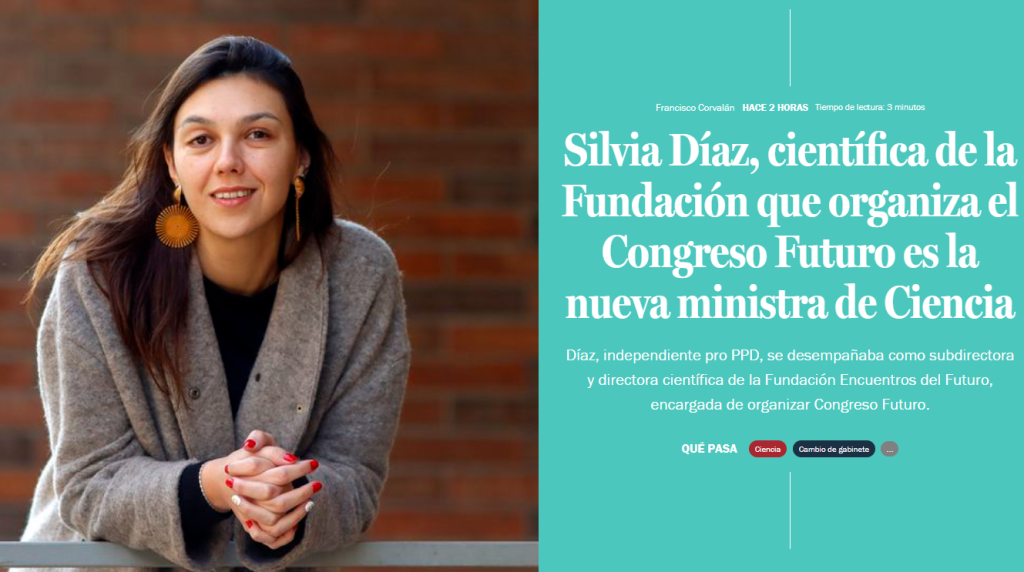
Source: La Tercera
From Congreso Futuro to the Government. Silvia Díaz Acosta (35) has become the country’s new Minister of Science and the first woman to hold the post since the ministry was created in 2019.
Díaz Acosta, a native of Ovalle, holds a PhD in Chemistry from the Pontificia Universidad Católica de Chile. She served as scientific director at the Fundación Encuentros del Futuro, leading the multidisciplinary team in charge of coordinating and producing Congreso Futuro, the largest knowledge outreach event in Latin America, and its parallel science outreach activities, such as Futuristas, which seeks to bring knowledge to children and young people through an interactive experience.
She has also devoted her time to promoting science and its role in society, taking part in the creation of the Ministry of Science, Technology, Knowledge and Innovation in 2018. Before that, she developed and advised various Science, Technology, Knowledge and Innovation projects, such as the science series Por la Razón y la Ciencia and the Consejo del Futuro. She has also been part of research teams at various Institutes of excellence belonging to the Millennium initiative.
For María Cecilia Hidalgo, president of the Chilean Academy of Sciences, Minister Díaz’s arrival is a challenge given the tasks left by Flavio Salazar. “(Silvia Díaz) has a lot of experience in science communication. She has devoted herself to outreach and has many contacts in the national and international political and academic worlds. I think she can do very positive work, although I was surprised by Minister Salazar’s departure. He is a highly prestigious and renowned scientist,” she said.
According to Hidalgo, the most important challenge the new minister must face is “ensuring that investment in CTCI lives up to the country we want to have. Because with 0.34% of GDP in total research investment we are not going to get anywhere in terms of development, or in solving the main problems we face as a country.” It is worth recalling that the government’s current proposal is to increase investment in science, with public and private contributions, until it reaches 1% of gross domestic product.
Meanwhile, Iván Suazo, vice-rector for Research and Doctoral Programs at the Universidad Autónoma de Chile, welcomed Díaz’s arrival and Salazar’s departure. “We are leaving behind a minister who struggled to settle into the role, with a biased view of the public-private relationship,” he said. He added that “from the scientific and technological ecosystem, we view positively the arrival of the country’s first female Minister of Science, not only because of the need to highlight the important role of women in leadership positions, but because she is one of the scientific directors of the largest outreach event in Latin America.”
Adriana Bastías, president of the Red de Investigadoras, celebrated the appointment, since “for the first time a woman takes office as Minister of Science, Technology, Knowledge and Research. We hope the gender agenda continues, is maintained and strengthened.” The scientist also said she hopes to continue along the line of dialogue maintained by the previous minister, Flavio Salazar.
Likewise, Jovanka Trebotich, technology transfer coordinator at Know Hub Chile and member of the ScienceUP Advisory Council, notes that Chile has taken great strides in gender equity in science and technology, reflected, for example, in the fact that Chile currently ranks third in the OECD for gender equity in science and technology patents. “But much remains to be improved in terms of the number of scientific articles published by women, the equitable career progression of women researchers at universities and research centers, support for increasing the number of women-led ventures, and increasing women’s participation in the labor market in knowledge-intensive sectors.”
Along the same lines, Trebotich adds that the appointment of Silvia Díaz as the new Minister of Science, besides setting a precedent as the first woman to head the ministry since its creation in 2018, is also a significant milestone for gender equity in science and technology, since it will give visibility to women’s work in this field and place greater emphasis on public policies with a gender perspective, “thus moving not only toward a knowledge society, but also toward an equitable one.”
Read the La Tercera article here