

What do poetry and innovation have in common? (Spoiler: neither cares about your little heart)

Know Hub News
· Santiago

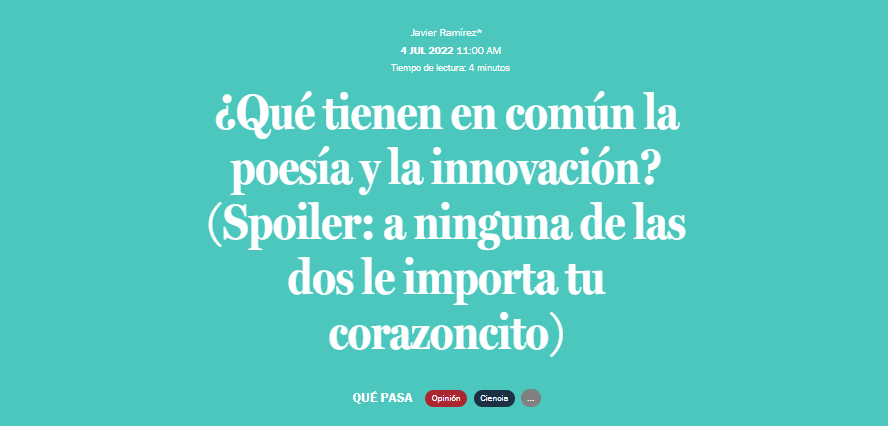
Source: La Tercera
Many years ago, still young, I signed up for a writing workshop believing they would teach me how to make a living from writing. Despite my obvious naivety, I was sure that whatever I learned, none of it would be useful outside the world of letters, in the “real world.”
It turns out I was wrong about that too.
The thing is, we are always telling a story: behind every request, negotiation or pitch there is a narrative, whether we are selling insurance, winning readers or seeking funding for our start-up. A common mistake when telling that story is to believe that what moves us will stir the same emotion in whoever is listening; so we think our poem about the child in the park will also remind the reader of their own childhood, or that the paragraph with a domestic anecdote will also evoke their mother’s home. The writing workshop summed up the disillusionment this lesson brought with the phrase “poetry doesn’t care about your little heart.”
In science-based innovation, we often meet researchers who, driven by curiosity or seeking to solve specific problems, achieve groundbreaking results for their discipline. With this technology under their arm, they set off on the long and painful road of meetings with potential customers, partners, investors, suppliers and authorities, telling over and over the story they believe is relevant: how they arrived at the technology, the solidity of the science behind it and the technical problems it solves.

Along the way, every now and then they will add an anecdote reflecting the long years of effort and dedication behind those results. But if poetry doesn’t care about your little heart, innovation cares even less. Then they realize that the solution they developed is not really a solution, and what seemed like the end of years of research is just a bend in the uncertain journey of turning that science into innovation.
That journey requires the systematic and methodological support of specialists who help understand, for example, why someone would use the proposed solution, what real problem it aims to solve, or who the competition is.
These may seem like obvious points. But they are not obvious to a researcher who, when asked about the value of their technology, says that after investing decades of their life they have managed to show that “… the molecule BIRCL4 is a mimetic of inhibitor of apoptosis proteins that block the final effectors of the caspase 9 and 3 pathway…” (a fictitious example, of course). A translation for non-scientists would be something like “a molecule that prevents hair loss,” a phrase that clearly describes what the technology does (its features), but not what it would be used for (its benefits), much less why it would be used (its value).
That seemingly Byzantine distinction affects key aspects of ensuring that the scientific result actually reaches society, such as determining what the market is and who we are competing against. In the case above, if we focus on what the technology does (preventing hair loss), the market will be the pharmaceutical world and we will probably identify Pfizer or Roche as our competitors. If we focus on its value, that is, the reasons why the customer is willing to acquire the technology, things can change significantly. So if the answer is “I want more hair to look more handsome”, the competition could be the plastic surgeons’ guild. It is a different story with “I want more hair so I can get a date”, in which case the competition will be Tinder.
Caricatures aside, being able to see things from the customer’s perspective improves the chances that technologies born from long R&D projects, usually funded by the public purse, can become concrete improvements in people’s lives, which in turn leads society to value the work of scientists and science more highly.
To round off the analogy, it is these concrete impacts that allow science to build a shared narrative with the community and become a knowledge-based society.
Read the opinion column published in La Tercera here: https://www.latercera.com/que-pasa/noticia/que-tienen-en-comun-la-poesia-y-la-innovacion-spoiler-a-ninguna-de-las-dos-le-importa-tu-corazoncito/O5JX6EKHKVB53FQHQFLPC546GU/