Dual Vision, a video analytics and computer vision startup, joins forces with an artificial intelligence company to expand its applications worldwide

Know Hub News
· Santiago
A group of engineers from the Universidad de Chile founded Dual Vision, a startup that, using computer vision and artificial intelligence, developed a system that gives companies real-time video analytics solutions to optimize their processes and make them more efficient. AI company Kauel Technologies recently invested in the startup to expand its applications worldwide using artificial intelligence.
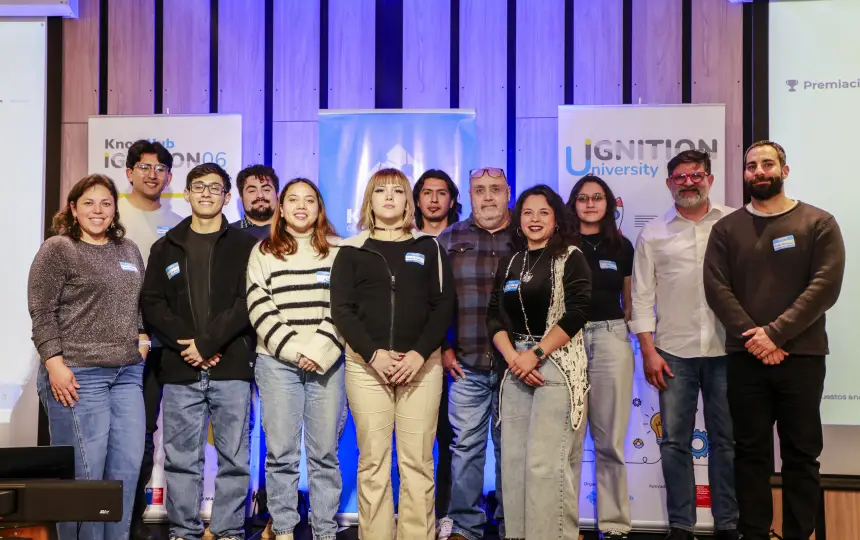
In 2020, Dual Vision took part in Open Bridge Covid-19, an initiative organized by Know Hub Chile and Open Beauchef of the Universidad de Chile.
Over the last decade, so-called artificial intelligence (AI) has made rapid progress. Its potential applies to many fields. In particular, AI is powering a very useful and promising discipline: computer vision.
This innovative branch of AI focuses on replicating human vision. It helps computer systems identify and process what they see in the same way humans do.
In this way, computer vision allows computers to understand the visual world. Using digital images and deep learning models, algorithms and systems are trained to accurately identify and classify objects and to react to certain behaviors and patterns.
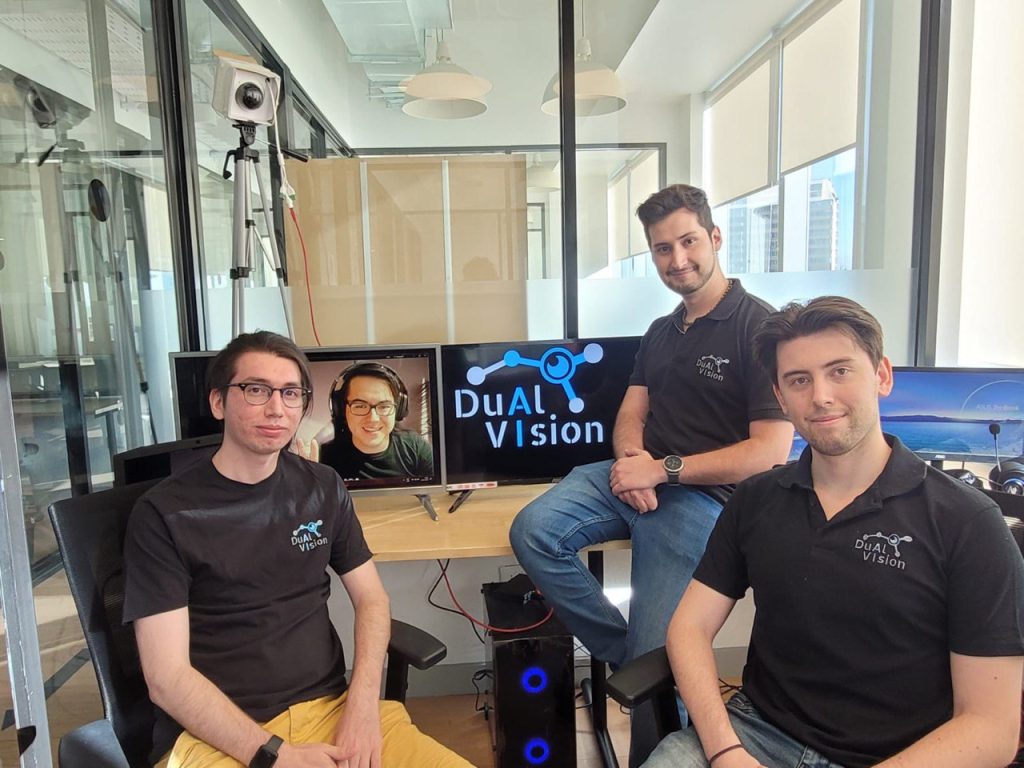
Thanks to this progress, surveillance cameras, for example, which are found in many places across the city, can not only observe but also analyze. This analysis, which makes it possible to streamline and optimize different processes, is what Dual Vision does. The startup, founded by engineers from the Universidad de Chile, digitizes spaces so they can be measured or analyzed, applying its computer vision expertise to monitoring cameras, which thus become the “smart eyes” of various companies.
Dual Vision was founded by four engineers from the Universidad de Chile: Giovanni Pais, Hans Starke, Juan Cáceres and Kevin Pinochet. According to Giovanni Pais, the company grew out of an interest in researching AI and computer vision in order to find solutions to real problems. The idea behind computer vision is to teach computers to interpret and understand images pixel by pixel. This is the foundation of the field of machine vision. On the technical side, computers seek to extract visual data, manage it and analyze the results using sophisticated software programs.
Alliance with Kauel
Dual Vision recently formed a strategic alliance with Kauel Technologies, a major player in the AI market, which invested in the startup to expand its applications worldwide using AI.
Kauel Technologies is currently a leader in computer vision in operations around the world through a Software as a Service model in energy (Oil & Gas and power utilities), connected with aerial operators, satellite systems and people who capture images, to detect imminent risks associated with assets, issue alerts and automatically generate navigable 3D models to obtain digital twins.
According to Pais, the milestone with Kauel represents an investment alliance that will allow them to join forces and expand. “Kauel has experience processing aerial images captured by drones, and they are also expanding in the United States, a large market with multiple challenges that we aim to tackle together. We have developed solutions at Santiago airport, and we want to take Dual Vision’s solutions to more places and new industries,” he says of the possibilities this alliance opens up.
Dual Vision has always sought to make an impact on society, Pais says, creating value for its clients through innovative solutions. This alliance with Kauel strengthens that vision. “It complements our technologies and will allow us to bring our solutions to more people and new markets. Together with Kauel, we want to boost the creation of high-level technology solutions from Chile, empower other companies and push processes toward Industry 4.0.”
What Dual Vision does is connect to clients’ existing cameras and run algorithms that can count and measure different things. With this, they establish physical behaviors and generate real-time information for faster reaction. “If an incident occurs, you can react instantly and get ahead of events that may happen, becoming more predictive or reactive. The more mature the solution, the more historical information you have to try to adjust to people’s behavior,” he says.
For example, a large building such as the airport has many cameras, Pais explains, and thanks to this technology, information can be collected from the selected cameras connected to Dual Vision’s software. This makes it possible to measure how long people take in certain processes and areas, improving the passenger experience and preventing crowding.
Open Bridge
In 2020, Dual Vision took part in Open Bridge Covid-19, an initiative organized by Know Hub Chile and Open Beauchef of the Universidad de Chile. Using computer vision technology, they developed Safe Vision to support prevention, planning and real-time decision-making in healthcare facilities, with a focus on the Covid-19 pandemic.
Safe Vision is a video analytics system for healthcare facilities that connects directly to their standard cameras to process images and generate metadata in real time. It counts occupancy and the flow of people (patients, companions and healthcare staff), checks the use of face masks and other personal protective equipment, and verifies compliance with social distancing.
“The experience at Open Bridge was very good. We had the chance to test the technology in another field. Working with the health center gave us a lot of experience that was reflected in later projects. That maturing process when we started was very valuable; the support they gave you, plus the tools, help you as an entrepreneur to tackle challenges at different stages and to shape the strategy for developing a business model for a new application,” says Pais.
Although other companies work with this technology, it is a fairly new field in Chile. “Not many companies work with it, and at Dual Vision we work with the latest research models in the world to reach better solutions. Those capabilities are scarcer, and we apply them to our projects, which allows us to create new solutions. We are working on projects for new markets, such as ports, production plants, vehicle and machinery analysis, industrial safety, quality control, etc.”
Kauel’s current investment is a boost to improve the technology and reach new markets with an AI solution that has gained, and will continue to gain, much more momentum in the coming years, Pais stresses: “Our business model is based on packaged solutions that work through licenses, so that companies can connect their cameras through our system and, on that basis, offer computer vision as a service. The idea is to keep expanding the range of analytics so that in the coming years people can access the platform, connect their cameras and create value by having real-time information to prevent accidents, protect the privacy of assets and make production processes more efficient.”