Elementum turns plastics into eco-fuel and organic solvents

Know Hub News
· Santiago

Originally founded as EcoFuels, this science- and technology-based venture can transform almost any type of plastic waste into liquid by-products with multiple applications, using a thermochemical process that involves no combustion and leaves no water footprint. So far they have processed up to half a ton of material, and their method has the advantage of accepting plastics that do not necessarily need to be washed, only dry.
Source: País Circular
While pursuing doctoral studies at the Faculty of Physical and Mathematical Sciences of the Universidad de Chile, Ariel Crespo and José Duguet set out in 2015 to create their own experimental design that could process plastic waste differently from conventional methods. In early 2018, they launched the company Eco-Fuels, which managed to produce an eco-fuel from different plastics through a thermochemical process that uses no combustion and leaves zero water footprint.
In an attempt to bring the brand to Europe, Crespo and Duguet (joined this year by Moisés Godoy) received not-so-good news: in 2020, the year the pandemic was at its peak, the European jury was very confident that the entire vehicle fleet would switch to electricity and that combustion engines would disappear. However, “the energy crisis is showing the opposite,” says Ariel Crespo, a Bolivian citizen by birth with a Chilean father. Together with his partner Duguet, he decided to open up to new customers and markets.
“We believe the potential is big, but then we rethought the venture and realized we could obtain different by-products from different plastics. We never got the same product from the same plastic. Plastics come with different degrees of recycling. We kept refining that and concluded that we could obtain an intermediate product: an organic solvent that can be used as a raw material to make lubricants or paint solvents,” Crespo adds.
That is how Elementum was born, a science- and technology-based SME that “is based on and uses all of EcoFuels’ technology; what changes are the thermodynamic conditions, and by setting them, the characteristics of the final product are modified/adjusted,” explains the company’s executive director. The business model also shifted: they moved from dealing directly with municipalities to working with companies, in order to help with the transition those companies must make with their waste under the Extended Producer Responsibility Law (Ley REP).
“We had started with a mix of plastics from municipalities that could be set up; then came the social unrest of 2019 and they lost interest because they focused on addressing social demands. We realized that each company had its own particular pain point,” adds the entrepreneur, who is a doctoral candidate at the same faculty of the Universidad de Chile.
The advantage of the system is that any plastic waste can be processed by Elementum and turned into eco-fuel or organic solvent. “They just have to arrive dry; it doesn’t matter if they’re not clean,” notes Crespo, who could process all types of plastics except PVC, which contains dioxins. They also do not work with PET plastic, since it already has a well-established market.
What they are currently processing are high-density polyethylene (oil, chemical and detergent containers), polypropylene (flexible plastic) and expanded polystyrene (Styrofoam), and even printer ink cartridges, from which the metal is extracted.
Elementum is currently running pilots with companies, tailoring them to their needs and the types of plastic waste they have. One example is Química Maguey, a manufacturer of cleaning products that works mostly with high-density polyethylene. With them, they are fine-tuning a process to generate a liquid by-product that will be used to produce mechanical maintenance lubricants, similar to WD-40.
“It’s a company located in Buin that, with its own waste and others, manages to produce an organic solvent that it then turns into this lubricant,” explains Ariel Crespo. He also explains that Elementum can treat the specific plastics used with chemical products. “Generally, those plastics can’t be recycled for human consumption because there may be residues of previous chemicals, and they basically end up in landfills,” he argues.
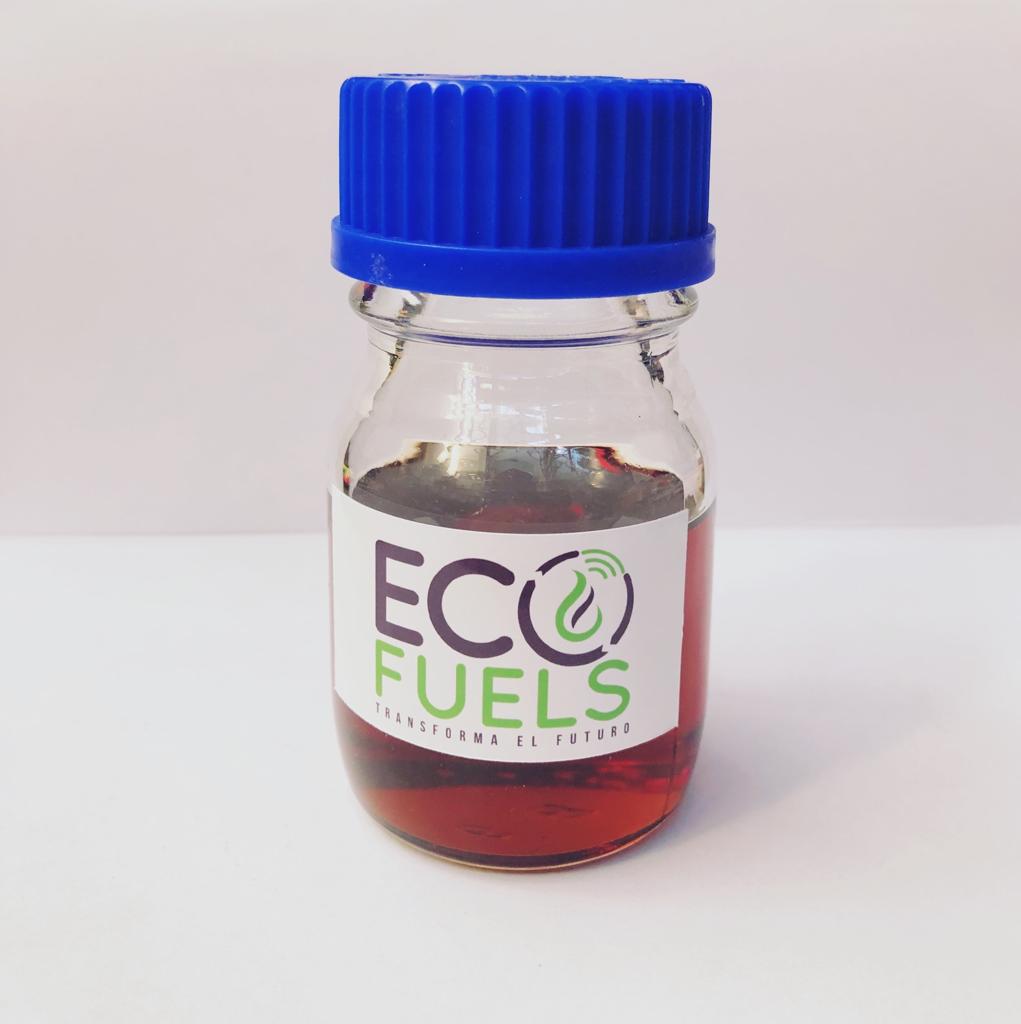
Each kilogram of processed plastic, the entrepreneur adds, can be turned into up to 750 ml of solvent. To date, they have transformed half a ton of plastics into organic solvents. “We don’t use water because we want to be as eco-friendly as possible,” Ariel Crespo adds. “From the different types of plastics and their characteristics, we obtain a final product that will depend on what the end customer needs.”
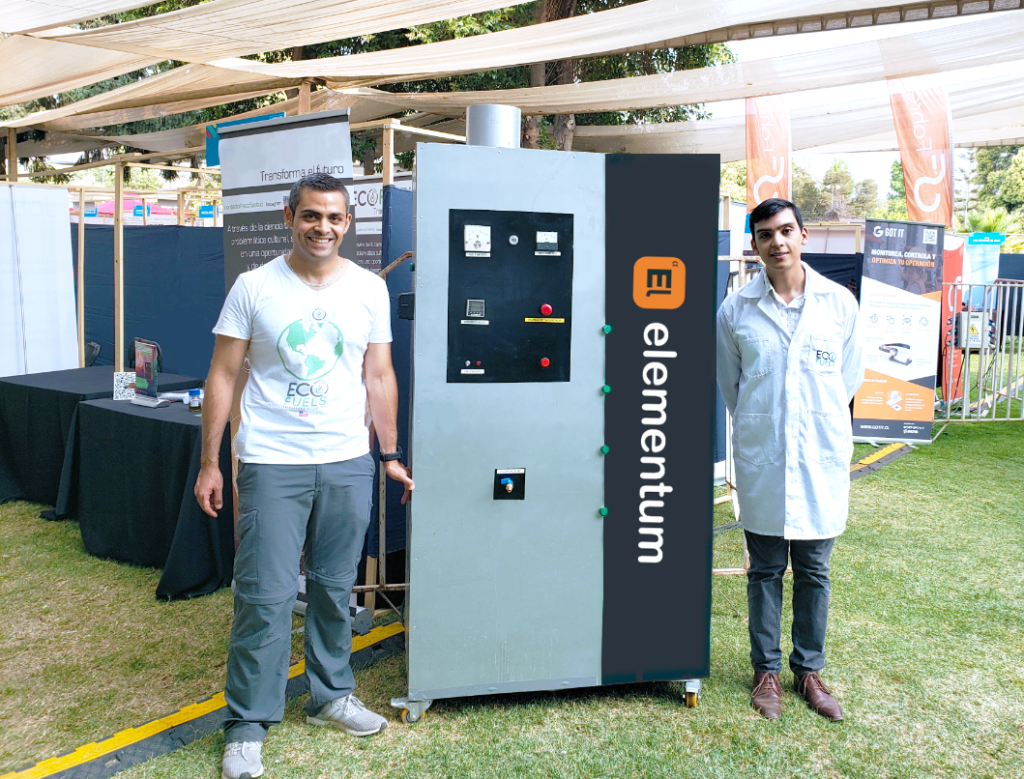
Elementum uses one or more portable units to carry out its work. However, with these alone they would not be able to meet their goal of increasing the recyclability and/or reuse of plastics so that they do not end up in landfills and oceans. For this reason, they designed new scaled-up units “whose processing capacity would be between 50 and 200 kg/day of plastics,” he says.
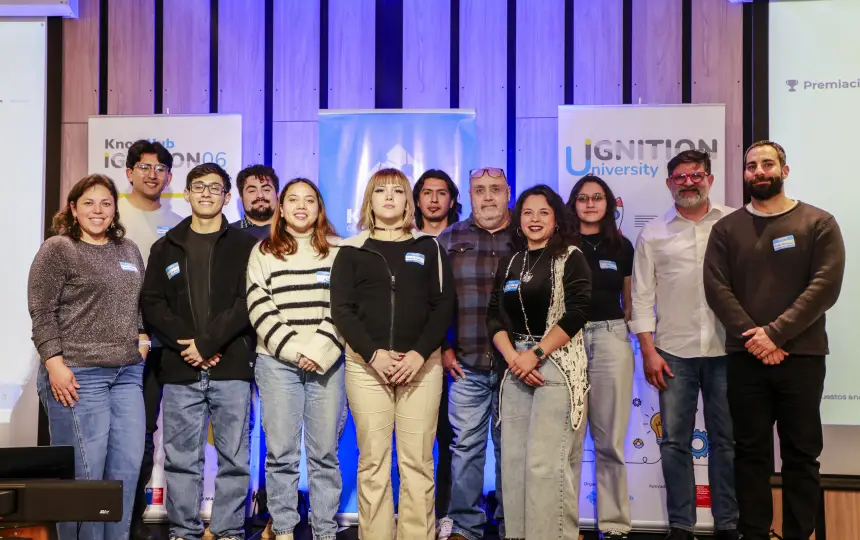
It is worth noting that in 2020, Elementum applied to Know Hub Ignition, Know Hub Chile’s program supporting the growth and maturation of science- and technology-based ventures, and was one of the winning teams. Since then, they have been part of the corporation’s portfolio, which has accompanied them on their journey as science- and technology-based entrepreneurs. “Elementum developed a plastic recycling system that achieves true circularity, making it a venture that applies science and technology to solve a problem that is urgent today not only in Chile but for the rest of the world,” says Javier Ramírez, executive director of Know Hub Chile.
Read the full article from País Circular here