Know Hub Chile promotes training to bring UACh research closer to new application opportunities

Know Hub News
· Santiago

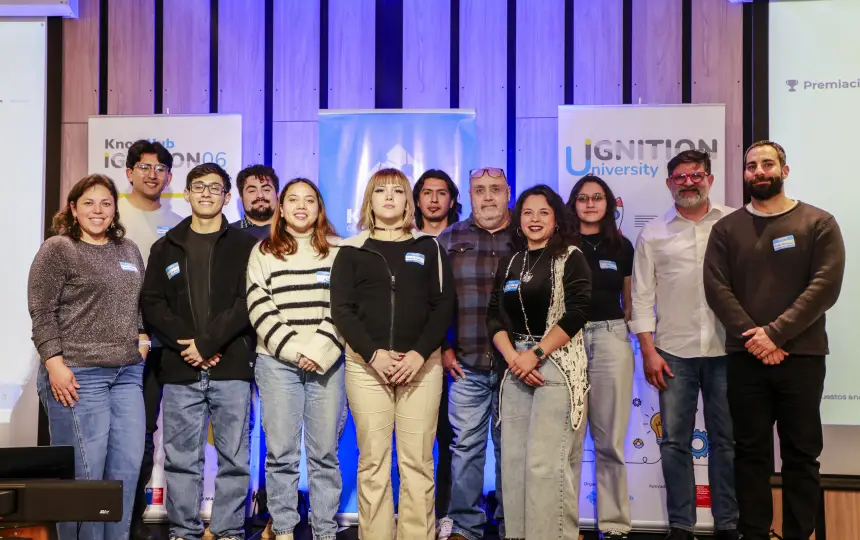
An in-person session held in Valdivia allowed researchers from the Faculty of Engineering Sciences to put communication and project presentation tools into practice, building on the content developed during the R&D&I+E+TT Training program run together with Know Hub Chile.
University research faces the challenge of clearly communicating the value of its results and envisioning their possible applications. With that focus, the workshop Science with impact: from research to market was held in Valdivia with faculty members from the Faculty of Engineering Sciences of the Universidad Austral de Chile, as part of the R&D&I+E+TT Training program developed together with Know Hub Chile.
The activity brought the content previously covered in virtual sessions into a hands-on setting. During the session, the researchers worked on building and delivering their pitches, presenting their projects to other participants and receiving feedback aimed at improving how they explain their research, identify application opportunities and communicate its potential for science and technology transfer.
The session also addressed how presenting to audiences outside academia requires translating specialized concepts, clearly identifying the problem a project seeks to solve and explaining why its results may be useful in other contexts.
Representing Know Hub Chile were Jovanka Trebotich, Director of Innovation and Technology Transfer; Oscar Astudillo, Director of New Projects; and Paulina Sepúlveda, Director of Communications. On behalf of the UACh Faculty of Engineering Sciences, participants included Paulina Gayoso, R&D&I+E+TT executive; Armando Blanco, Vice Dean; and Felipe Vargas, head of the Research and Development Office.
From the lab to application
Armando Blanco, Vice Dean of the UACh Faculty of Engineering Sciences, highlighted this type of training because it broadens the perspective from which faculty members approach their research.
“In academia, our focus is often on the product we develop and its scientific grounding. We don’t always envision what its path to market might be or how to put it into operation. This type of training helps us move toward an application-oriented view and have people who accompany us on a path we have rarely traveled. For faculty members, it is also a learning experience and an opportunity to look at what we do from a different perspective,” he said.
Along the same lines, Paulina Gayoso, R&D&I+E+TT executive at the Faculty of Engineering Sciences, emphasized the importance of creating dedicated spaces for researchers to develop their communication skills. “Faculty members spend much of their day-to-day on research and on developing the technical aspects, but there are few opportunities to practice and strengthen their communication skills,” she said.
Researchers usually go straight from the lab to publishing a project, writing a paper or applying for funding. That is why, Gayoso noted, “having spaces for practice and feedback is very valuable, because it allows them to strengthen the way they present their projects and communicate their potential.”
Oscar Astudillo underscored the value of working directly with researchers on their own projects, adding a perspective that helps recognize transfer opportunities from early stages: “When a researcher manages to clearly explain what problem their project addresses, what the value of the proposed solution is and who could use it, new possibilities open up for conversations with players outside academia. Working on these skills based on real projects makes communication part of the development process rather than something confined to a later stage.”
The session concluded with the presentation of diplomas to the participants and a talk on innovation and technology transfer open to the university community, given by Oscar Astudillo, Director of New Projects. It addressed the role universities can play in generating new opportunities from research and the importance of developing capabilities that facilitate the connection between knowledge, application and the wider environment.