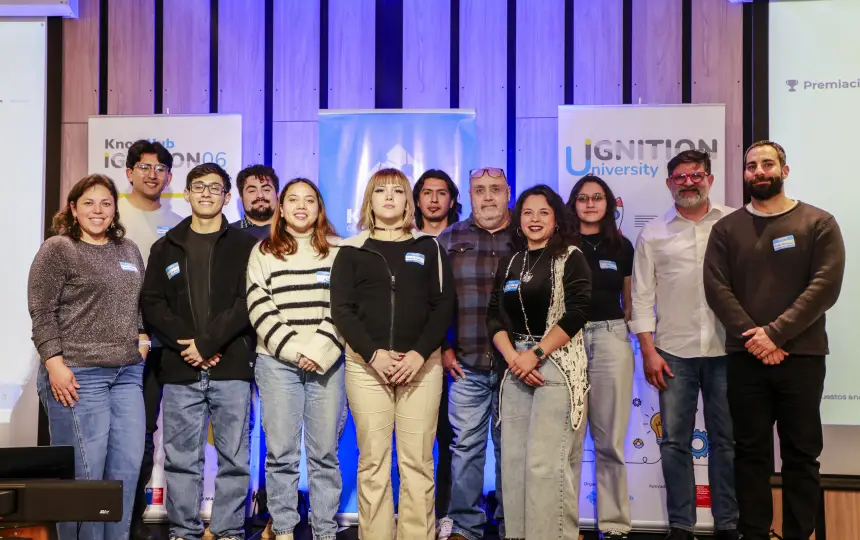

Oscar Astudillo, technology transfer coordinator at Know Hub Chile, elected president of the Red de TransferenciaAP

Know Hub News
· Santiago

Made up of the National Transfer Networks of the Pacific Alliance member countries (Chile, Colombia, Mexico and Peru), its goal is to strengthen and coordinate these countries’ technology transfer capabilities, integrating and expanding them to establish a regional space that allows both companies and startups to use and commercialize technologies.

How do you measure innovation? A country’s impact and innovative capacity has one figure that leaves no room for doubt: registered patents. According to the World Intellectual Property Organization (WIPO), that number places China as the nation with the largest number of patent applications in 2021.
In this measure of technological leadership, the United States ranks second, followed by Japan and South Korea. In fifth place is the European Patent Office.
No Latin American country appears in the “top ten.” However, Brazil stands out in 11th place and, a little further down, Mexico (15th).
Action is needed so that more countries from the region reach these top positions. That is the work of the Red de TransferenciaAP, a regional integration initiative made up of the National Transfer Networks of the Pacific Alliance member countries: Chile, Colombia, Mexico and Peru. This work is supported by the Competitiveness, Technology and Innovation Division of the Inter-American Development Bank.
And recently, for the first time since its creation in 2018, this organization has a Chilean representative as president: Oscar Astudillo, technology transfer coordinator at Know Hub Chile, with more than 12 years of experience in innovation management and technology transfer processes, who is also a board member of the Red de Gestores Tecnológicos de Chile.
Among the different proposals to lead the institution in the current term, Astudillo’s was chosen by vote at the board meeting. Alongside Astudillo, Santiago Prat, a member of the Red de Gestores Tecnológicos de Chile, also took office as Chile’s representative in TransferenciAP.
Driving technology transfer and adoption
Made up of the networks of technology transfer offices, technology managers or similar bodies in each of the Pacific Alliance countries, this institution coordinates the activities agreed by its members to boost technology transfer and adoption capabilities. It also fosters technology-based entrepreneurship through collaborative projects to increase their capabilities and the exchange of good practices.
All of these actions are coordinated by its board, headed by Astudillo, together with a representative from each country and a president, plus another representative from each member that temporarily holds the presidency of the Red de TransferenciaAP.
Building a platform that drives technology commercialization is something the technology transfer coordinator at Know Hub Chile sees as one of his main goals at the institution. “Technology commercialization is an important aspect, and the platform is relevant for that, along with building a foundation of trust for the different sources of funding, both private and public,” says Astudillo.
Through the Red de TransferenciAP, it is possible to help develop and promote science, technology and innovation for productive purposes in the Pacific Alliance, highlighting their importance as tools to improve competitiveness in its member countries.
It is also made up of four commissions: Commission 1, Promotion and Linkage for Technology Supply and Demand; Commission 2, Linkage and Convergence with other AP networks; Commission 3, Enablers for human capital development, metrics and sustainability of the Network; and Commission 4, Regulatory Framework and Public Policy on Technology Transfer and Intellectual Property. Astudillo was coordinator of Commission 1 on Promotion and Linkage for Technology Supply and Demand.
Transferencia AP, Astudillo notes, follows a cooperative working model aimed at improving standards and best practices in technology transfer and, along with that, achieving impactful results both in its member countries and in the region.
2023 challenges
Astudillo’s term as president runs from January 2023 to January 2024, a period that the specialist acknowledges presents multiple challenges.
Among them, he highlights, are applications for funding projects with the Inter-American Development Bank. In addition, he says, “identifying the necessary challenges in all the countries of the alliance that are relevant to achieving a working structure that is developed sustainably, along with bringing in other countries such as Ecuador. In terms of work it will be a demanding year; we believe this integration initiative will allow us to manage collaborative activities among the member countries.”
And in all this work, he says, he highlights the organizations that make it possible: the national transfer networks of the member countries. Just as Chile has the Red de Gestores Tecnológicos, the other member countries also have such institutions, which are the foundation of this process.
“Chile, in turn, leads these processes in the region because we are more advanced in organizational structures, a benchmark especially now that a technology transfer law for Chile is being discussed,” he says.