
The Chileans turning plastic into eco-fuel

Know Hub News
· Santiago

Making plastic stop being plastic. That is the solution proposed by a Chilean science- and technology-based startup in the Know Hub Chile portfolio which, using portable equipment with a zero water footprint, converts plastic waste into an organic liquid with multiple applications.
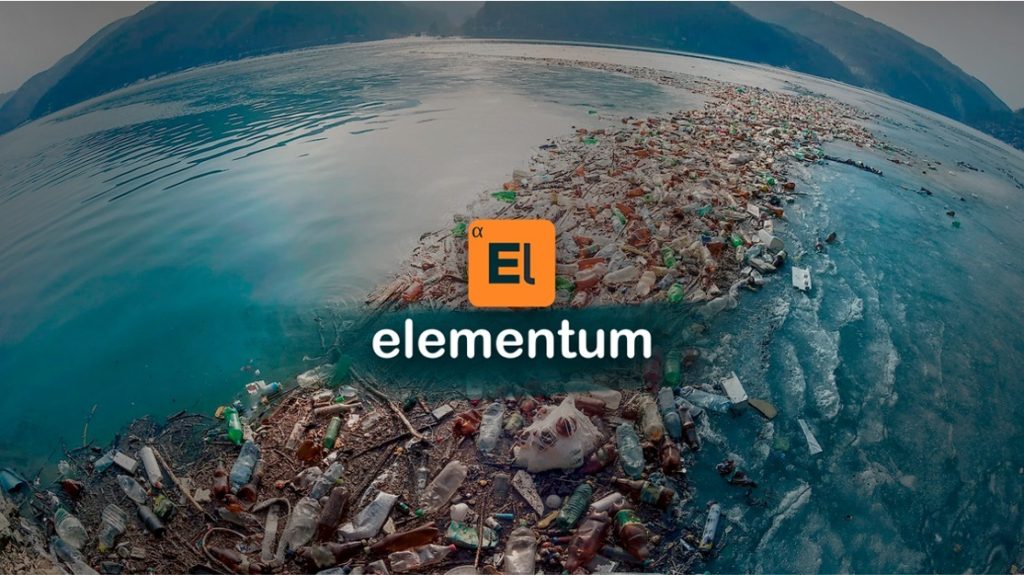
Plastic is one of the defining elements of modern life. From food packaging to spacesuits, it is a versatile and inexpensive material used in a vast range of products.
Since the 1950s, industrial plastic production has grown rapidly. Today, more than 300 million tons are produced worldwide each year, and about eight million of them end up in the ocean.
Thanks to its chemical composition, it has become a very useful and durable material (it can take many decades, up to a century or more, to break down), making it almost impossible to eliminate. All of these characteristics have made it a serious threat to ecosystems around the world.
In Chile it is an urgent problem. Approximately 990,000 tons of plastic are consumed each year, of which 83,679 tons (8.5%) are recycled.
Dealing with plastic pollution requires creativity and recycling technologies that help with waste management.
What if plastic were a raw material? That is what a technology created by Chileans does, turning the plastic problem into a solution. It is Elementum, a portable, scalable, easy-to-use modular device that, through a highly efficient thermochemical process (up to 75%), adds value to plastic waste and transforms it into organic solvents with multiple applications, such as lubricants, paint solvents or fuel additives.
Ecological fuel
Elementum converts plastic into ecological eco-fuels. It began as an idea in 2015 by two doctoral students at the Faculty of Physical and Mathematical Sciences of the Universidad de Chile, Ariel Crespo and José Duguet, who sought to create their own experimental design capable of processing plastic waste more efficiently and effectively than existing methods. Entrepreneur Moisés Godoy joined the team this past year.
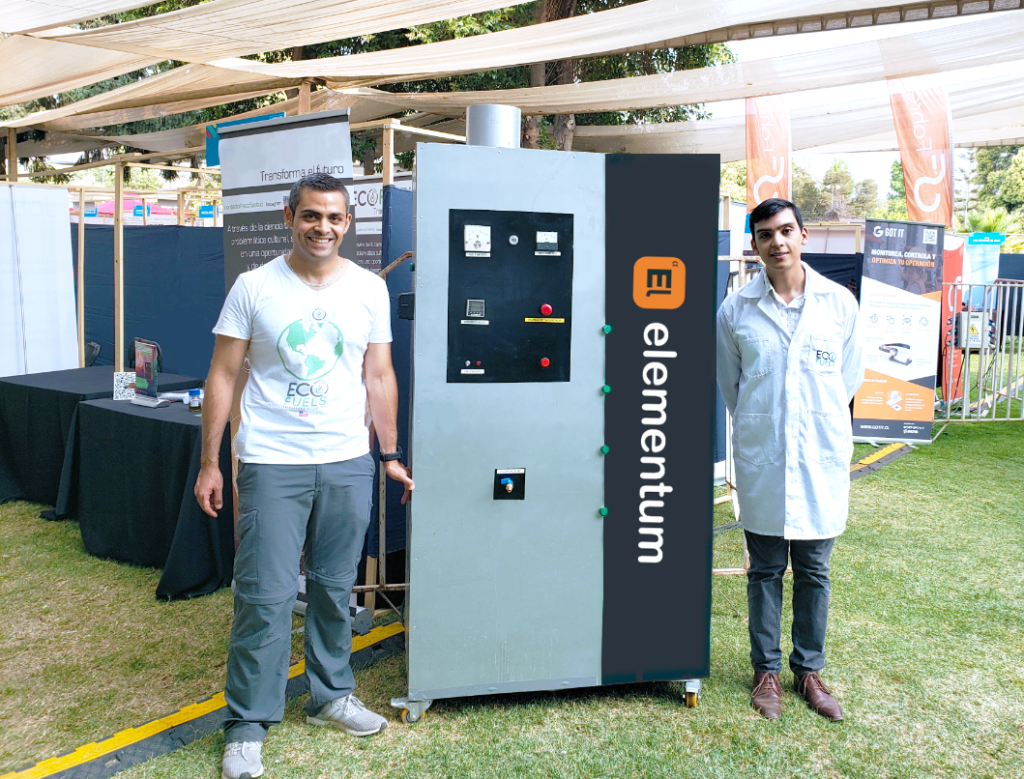
Ariel Crespo, CEO of Elementum and a student in the Department of Chemical Engineering, Biotechnology and Materials (DIQBM) at the Universidad de Chile, says the project started with the aim of treating plastic differently from conventional recycling. “More than 90% of the plastic produced is not recycled because of logistics, contamination with impurities, the limits of conventional recycling, and costs due to the long distances between collection points and recycling plants, as well as problems cleaning and sorting it for recycling,” he says.
The goal of the technology is to reduce the high logistics costs of traditional plastic recycling by up to 80%, especially for institutions that must comply with the Extended Producer Responsibility and Recycling Promotion Law (REP).
What technology does it use? Crespo says they developed their own thermochemical process: “this process has a number of advantages: there is no combustion, so it doesn’t generate CO2, and it doesn’t need water, because the plastics don’t need to be washed; in other words, its water footprint is zero.”
This technology transforms a wide variety of plastics into an organic liquid that can be used as a paint solvent, as a lubricant or anti-corrosion agent for mechanical maintenance, or as a fuel additive or fuel for home heating or industrial use. “The final product will depend on what is most favorable for the customer and their industry,” he says.
In addition to being portable and scalable, Elementum works with separated or mixed plastics. And that is not its only advantage, Crespo explains: “the technology does not require the plastics to be clean, which avoids using approximately 5.3 liters of water to recycle one kilo of plastic (zero water footprint).”
From innovation to entrepreneurship
The road to this technology solution was complex. Crespo acknowledges that the hardest part was being a science- and technology-based startup focused on a physical-chemical process rather than on digital, “which is where most startups in Chile and around the world have emerged from.”
“Fortunately, thanks to the Know Hub Ignition program, Elementum has been able to go from being a science- and technology-based innovation to a science- and technology-based venture: we have achieved our first sales and are optimizing both the initial process and our business model,” says Crespo of the Know Hub Chile program, which supports the creation and maturation of technology-based startups to promote innovation in the country by transferring research results for the benefit of society, and in which they were one of the winning teams in 2020.
“We are moving from an academically focused mindset to a scientific-business one, where it is not enough to have a good idea; it also has to generate revenue. At the same time, this drives constant improvements in our team and in our technology, which allows us to dream of generating revenue through constant innovation, acting as a bridge between academia and science-based business,” Crespo emphasizes.
They are currently running pilots with this technology and adapting to the needs and types of plastic their customers have. One case is Química Maguey, a company that produces cleaning products and mainly uses high-density polyethylene, “so we are adjusting the process so that, as a by-product of recycling it, we generate a liquid that will be used to produce mechanical maintenance oils, like WD-40,” he says.
Crespo also notes that, given the high demand for plastic and the large volumes discarded every day, they realized that one or several portable units would not be able to meet their goal of increasing the recyclability and/or reuse of plastics so they don’t end up in landfills and oceans. That is why they designed new scaled-up units “with a processing capacity of between 50 and 200 kg of plastic per day,” he says.